


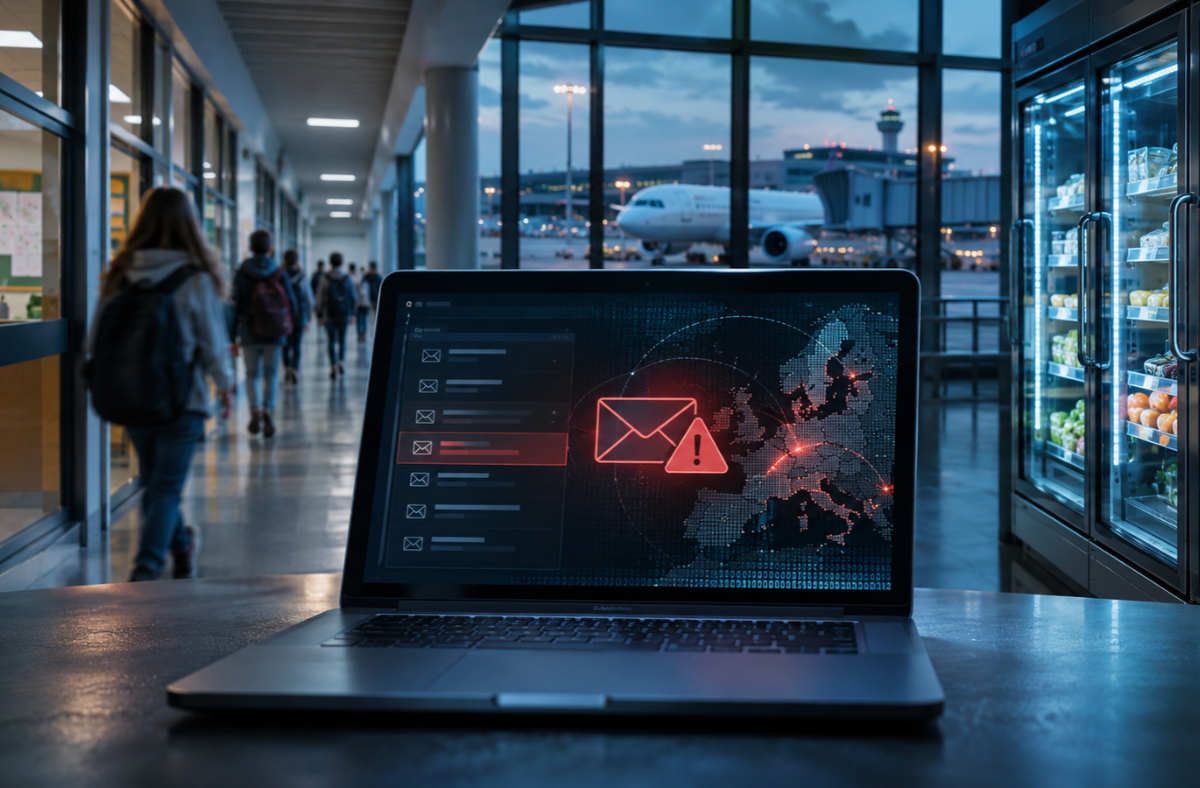
Threatening emails sent to schools, bomb threats affecting commercial flights, and cyberattacks targeting refrigeration systems. Recent incidents across Europe highlight why cybersecurity prevention and digital resilience are essential to protecting people, businesses, and services.
School Alerts: Thousands of Threatening Emails
Can a single email disrupt an entire country? Recent events show just how deeply digital communications can affect everyday life.
On November 11, 2026, approximately 6,300 Italian schools received emails containing bomb threats. The messages triggered precautionary evacuations, police interventions, and widespread concern among students, teachers, and families.
A second wave of messages followed the next day. According to la Repubblica, another 3,788 school email addresses were targeted, resulting in the evacuation of 77 schools.
As reported by ANSA in its coverage of the school alerts, investigations found no evidence of an actual threat. Nevertheless, the organizational and social consequences were immediate.
Strictly speaking, this was not a cyberattack targeting school IT systems. Rather, it was a campaign of threatening messages distributed through digital channels.
The incident raises a fundamental point: digital security is not just about protecting data. It is also about ensuring service continuity and safeguarding people’s safety.
From Aviation to Supermarkets: Other Recent Incidents
Italian schools were not the only institutions affected by incidents capable of disrupting everyday activities and essential services.
In the preceding days, a series of false bomb threats had affected several European commercial flights. The alerts caused diversions, delays, additional security checks, and, in some cases, the deployment of military fighter jets.
According to Reuters, the incidents disrupted air travel despite no explosive devices being found.
France: Cyberattack on Refrigeration Systems
A different type of incident involved the Établissement Français du Sang (EFS), France’s national organization responsible for blood collection and management.
In France, a cyberattack targeted several refrigeration systems operated by the organization.
As documented by Le Monde, the temperatures of certain refrigeration units were remotely manipulated. The incident potentially jeopardized the storage conditions of essential biological products.
Thanks to the swift response of staff and existing safety mechanisms, damage to blood supplies was prevented.
Supermarkets: Cyberattacks on the Cold Chain
The retail sector has also experienced similar incidents.
Since October, several European supermarkets have been targeted by cyberattacks affecting their refrigeration systems. Temperature fluctuations compromised the storage of certain food products, resulting in financial losses.
The incidents affected several countries, including Italy, as reported by Euronews in its coverage of supermarket refrigeration incidents.
These events should not necessarily be attributed to a common source. However, they reveal a shared reality: our growing dependence on digital technologies makes cybersecurity a priority for society as a whole.
When Cybersecurity Goes Beyond the Digital World
For years, cyberattacks have been primarily associated with data theft, ransomware, and breaches of corporate IT systems. Today, however, the scope of cyber risk extends far beyond these threats.
A compromised infrastructure can disrupt cold-chain operations, generate financial losses, or interfere with industrial processes. In some cases, it can even affect the availability of essential services.
Connected Infrastructure, New Vulnerabilities
Digital transformation has made IT systems, connected devices, and technologies controlling industrial equipment and machinery increasingly interdependent.
This integration creates significant opportunities for innovation and efficiency. At the same time, it expands the potential entry points available to attackers.
Recent incidents across Europe demonstrate how the consequences of cyber threats can extend well beyond computer screens and corporate networks.
Digital security has therefore become an integral part of physical, economic, and societal security.
Cybersecurity Prevention: Staying Ahead of Risks
As cyber threats become increasingly sophisticated, responding to incidents is no longer enough. The real challenge is to anticipate risks before they materialize.
Cybersecurity prevention is now a strategic investment for businesses, public administrations, and essential service providers.
It means understanding digital infrastructure, identifying vulnerabilities, and detecting suspicious activity at an early stage. It also requires effective procedures for managing potential incidents.
From Technology to a Culture of Security
An effective cybersecurity strategy must address not only IT systems but also the business processes that depend on them.
Network segmentation, system updates, access controls, and continuous monitoring are essential safeguards. Vulnerability management and employee training are equally important.
Organizations must also understand their technological dependencies and establish alternative procedures to maintain their most critical services.
After all, prevention is not just about technology. It requires awareness, collaboration, and an organizational culture built around security.
Digital Resilience: Ensuring Service Continuity
Alongside prevention, another fundamental concept is gaining importance: digital resilience.
Being resilient means maintaining operational capabilities even during an incident. The goal is to minimize disruption and restore normal operations as quickly as possible.
In a healthcare facility, for example, the priority is to safeguard patient services. In the retail sector, ensuring proper food storage is essential. For schools, the focus is on maintaining educational continuity while complying with guidance from the relevant authorities.
Business Continuity as a Strategic Priority
Cybersecurity can no longer be viewed as a purely technical matter. It must become an integral part of an organization’s overall risk management strategy.
Incident response plans, recovery procedures, and continuous monitoring all help reduce the impact of operational disruptions.
Every period of downtime can result in additional costs, service interruptions, and a loss of trust.
Olidata: Prevention and Innovation for a More Secure Digital Future
In a landscape shaped by constantly evolving cyber threats, Olidata recognizes cybersecurity as a strategic pillar of digital transformation.
Through specialized expertise and advanced technological solutions, the Group supports businesses and public administrations in protecting their IT infrastructure.
With Olidata Cybersecurity, the Group company specializing in advanced cybersecurity services, this commitment takes the form of an integrated approach.
Its activities include prevention, vulnerability assessment, continuous monitoring, and threat intelligence. Protection extends beyond traditional IT infrastructure to connected devices and industrial control systems.
The goal is to help organizations adopt a more proactive security model, reduce risks, and strengthen operational resilience.
Investing in cybersecurity means protecting not only digital infrastructure, but also service continuity and the trust of the people who depend on it.